Most St. Louis job sites need one portable toilet per 20 workers under a 40-hour week, plus a dumpster, temporary fencing, and sometimes a handwashing station if crews are spraying anything. St. Louis Porta Pros bundles all four so your superintendent makes one call instead of four, and construction portable toilet rental is the piece most crews order first.
OSHA 1926.51(c) sets the baseline: one toilet facility for 20 or fewer workers, then a seat and urinal added per 40 workers once you pass that threshold, scaling down to one per 50 once you hit 200 or more on site. That is the number an inspector checks first, and it is the core of osha portable toilet requirements construction crews get asked about most. Most residential and light commercial jobs in St. Louis run one or two standard porta potty rental units for the length of the project, delivered and swapped on a regular pump schedule, which is how portable toilet rental for construction sites usually gets set up from day one. Bigger sites add a second or third unit rather than making crews walk across the lot. If your crew is using paints, coatings, herbicides or insecticides, OSHA 1926.51(f)(1) kicks in separately and requires washing facilities on top of the toilets, which is where a handwashing station rental or a portable sink rental earns its spot on the site plan. Water itself is covered too: OSHA 1926.51(a)(1) requires an adequate supply of potable water at any place of employment, so a site without a spigot needs one trucked in or stored. Crews asking about cal osha portable toilet requirements construction rules for jobs outside Missouri should know state plans can add stricter numbers on top of the federal 1926.51(c) baseline, so always confirm with the state agency running the site. We run this same setup for crews working near University City, 7.9 miles northwest, and out toward Kirkwood, 12.5 miles west.
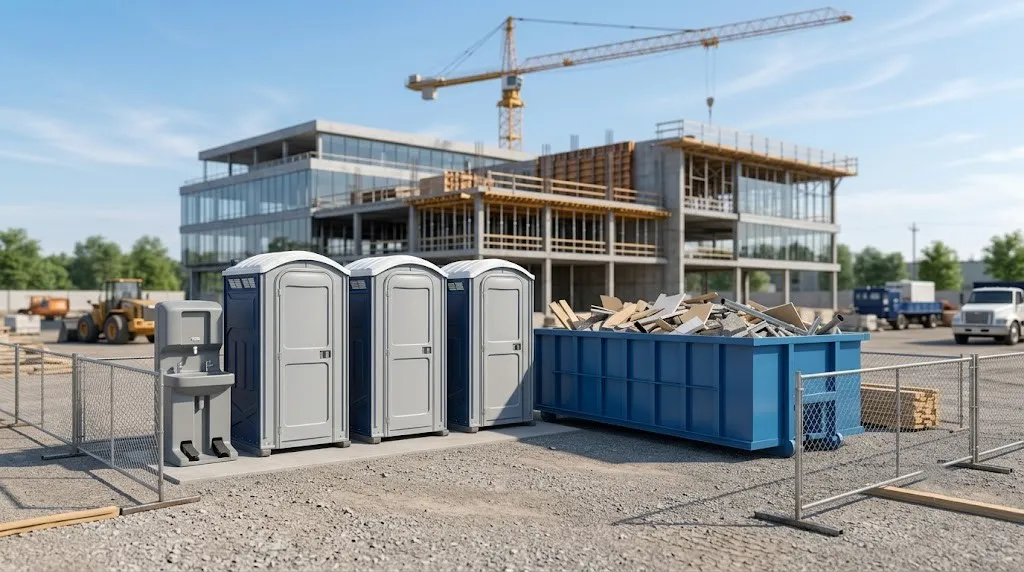
Start with headcount and shift length, then check it against the how many porta potties do I need guide before you order. A 15-person crew working a standard 40-hour week clears the OSHA 1926.51(c) minimum with a single unit, but most GCs in St. Louis add a second once the crew tops 25 or the site spans more than one building. Site layout matters as much as headcount. A unit is about 44 by 48 inches on the ground and stands roughly 92 inches tall, so tuck it somewhere workers can reach in under a couple minutes without crossing active equipment paths. Our porta potty placement guide covers ground stability and access lanes in more detail. Rentals typically run week to week through the build; a standard unit rented by the week falls between 130 and 500 dollars depending on service frequency and duration, which is cheaper per day than daily delivery once a job runs past a week or two. Full breakdowns live on our porta potty rental cost and porta potty rental per day pages.
Pricing depends on unit type, rental length, and how often it gets serviced. Here is what construction crews in St. Louis typically pay for portable toilet rental for construction sites cost, whether the job runs a week or a full season:
| unit | day | week | month |
|---|---|---|---|
| standard | 100-350 | 130-500 | 125-325 |
| deluxe flushable | 85-1200 | 150-290 | -- |
| ADA accessible | 200-400 | 120-240 | -- |
| delivery fee | 100-500 | 50-150 | 120-420 |
Long jobs almost always favor a monthly porta potty rental over week-to-week billing, since the per-day cost drops the longer the unit stays put. ADA units cost more per week than a standard unit runs per month in some cases, which surprises GCs who assume accessible units are a minor upcharge. If your site has any public foot traffic or falls under accessibility rules, check our ADA restroom requirements page before you order, since ADA Standards section 213.2 requires at least 5 percent of clustered single-user units to be accessible, and never fewer than one. Delivery fees stack separately from the unit rate, and multi-unit orders often qualify for a flat delivery charge instead of paying per unit.
Most active job sites need both, not just toilets. A roll-off dumpster rental keeps debris clear per OSHA 1926.25 housekeeping rules, and OSHA 1926.252 governs how waste gets disposed of on site, including chutes and enclosures for taller builds. Dumpsters need about 60 feet of straight clearance behind the delivery truck, so confirm your site access before delivery day, especially on tighter urban lots near downtown St. Louis. Weekly dumpster rates run from 426 to 778 dollars depending on size, with 10 yard, 20 yard, and 30 yard dumpster rental options covering most residential-to-mid-commercial jobs. Larger teardown or new-build sites often need a 40 yard dumpster rental instead. Pair that with a temporary fence rental or chain link temporary fence at 30 to 75 dollars a day to keep the public off an active site, which matters more in denser St. Louis neighborhoods than out past Chesterfield, 19.2 miles west, where lots sit further back from the street. If you are staging materials or need secure equipment storage, a storage container rental rounds out the site setup without renting a second trailer. Crews working further out near St. Peters, 27.0 miles northwest, still get the same delivery windows, and crews searching for construction portable toilet rental near texas from out of state should still call the local yard, since delivery windows and rules do not carry across state lines.
OSHA 1926.51(c) requires one toilet facility for 20 or fewer workers, scaling to one seat and urinal per 40 workers once you exceed that, then one per 50 at 200 or more. This is a construction-specific standard, separate from the general industry rule under 29 CFR 1910.141(c)(1)(i). Check our OSHA portable toilet requirements page for the full breakdown.
The industry baseline under ANSI/PSAI Z4.3 is one service visit per week for up to 10 users over a 40-hour week. High-traffic sites or crews working paint and coating jobs often need twice-weekly service instead. See how often are porta potties cleaned for scheduling details.
Placement in the public right of way needs confirming with the city before delivery. We do not guess at permit rules here; check with St. Louis before setting a unit near a sidewalk or street. Our porta potty permit requirements page walks through what to ask.
A standard unit runs about 44 by 48 inches on the ground. ADA units are larger, built around ADA Standards section 304.3.1's 60 inch turning circle and section 404.2.3's 32 inch clear door opening, so wheelchair users can enter and turn inside. Details are on our ADA accessible porta potty page.
Yes. Handwashing stations rent independently and are required under OSHA 1926.51(f)(1) whenever crews apply paints, coatings, herbicides or insecticides. 29 CFR 1910.141(d)(2) also requires soap and towels or a hand-drying device, not just sanitizer. Visit handwashing station rental for options.
Yes. St. Louis Porta Pros delivers construction site services across St. Louis and the surrounding metro, with same-day and next-day drop-off available on most orders.
Pricing depends on the unit and how long you need it. See our cost breakdown and request a free quote for an exact figure.
Standard rentals include scheduled service — a pump-out, a clean, a restock and fresh deodorizer. Busy or hot-weather sites can be serviced more often.
Call now or request a free quote — clean units, on-time delivery, transparent pricing.