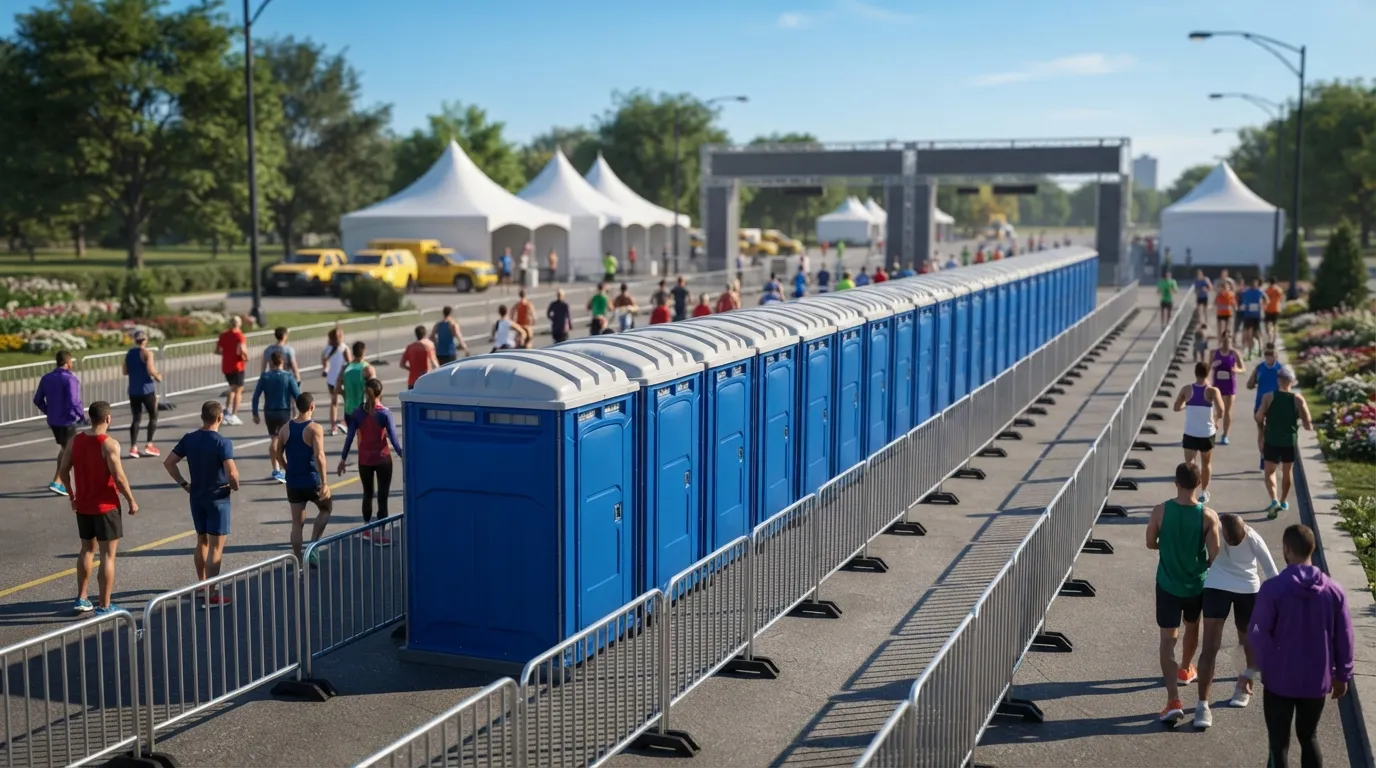
A 5K start line needs fewer units than a marathon finish festival, but the rule of thumb holds: plan on one standard unit per 200 to 250 runners plus extra near the finish chute, where lines bottleneck. St. Louis Porta Pros builds race-day layouts around your course map, not a flat headcount.
Start corrals, aid stations and the finish festival each pull crowds differently, so marathon and race restrooms get planned zone by zone, not as one lump number. A start line with 3,000 runners waiting 40 minutes needs a real cluster of standard porta potty rental units, while a mid-course aid station might only need two. ANSI/PSAI Z4.3 sets the baseline service interval at once per week for up to 10 users over a 40 hour week, which tells you units fill up fast under race-day density and short windows. Finish festivals in St. Louis often run longer than the race itself, with spectators, vendors and food trucks staying for hours, so we usually recommend adding event restroom rental blocks near stages and beer gardens. For a race that draws family crowds, a few deluxe flushable porta potty units near the finish line reads better in photos and keeps the line moving. Every cluster of portable toilets also needs an accessible unit under ADA Standards section 213.2, which requires at least 5 percent of clustered single-user units to be accessible, and never fewer than one. We size courses the same way we handle festival restroom rental and concert restroom rental events: walk the map first, then place units.
Race organizers usually mix daily and weekend rentals depending on how long the course stays set up, and the breakdown below covers the units we place most on race weekends.
| unit | duration | typical price |
|---|---|---|
| standard | weekend | $250 |
| ada | weekend | $240 |
| deluxe | weekend | $250 (week rate) |
| service_fee | weekend | $700 |
A weekend rate covers Friday setup through Sunday teardown, which fits most marathon and half-marathon schedules better than a single day rate. Full porta potty rental cost and porta potty rental per day breakdowns are on separate pages if your event runs shorter or longer than a typical weekend. Courses that also need a mobile command post or medical tent sometimes add a temporary power pole, and bracing it correctly matters on open ground: knowing how to brace a temporary power pole matters here: it needs to be set plumb, guyed or braced against wind load, and kept clear of the runner corridor and any vehicle staging lanes. If your finish festival runs into the evening, pair that power setup with a light tower rental so vendor areas and restroom rows stay lit. For courses through University City, 7.9 miles northwest of downtown St. Louis, or Webster Groves, 8.6 miles southwest, delivery timing should account for road closures along the route itself, not just distance from our yard.
Placement follows the crowd, not the finish banner. Start corrals need units set back from the timing mats so lines don't spill into the corral itself, and aid stations at mile markers need at least one unit each if the race runs longer than 90 minutes. Our porta potty placement guide covers ground clearance and access lane width in more detail, but the short version for race day: keep a clear path at least 36 inches wide to each unit, per ADA Standards section 403.5.1, and make sure the door swings without blocking that path. Units on grass or gravel need stable, firm, slip-resistant footing under ADA Standards section 302.1, which matters more on cross-country style courses through St. Louis parks than on closed city streets. If your event also needs temporary fence rental to keep spectators off the course or crowd control barrier rental at the finish chute, we coordinate that delivery with the restroom drop so trucks aren't fighting each other for the same curb space. Courses that finish near a venue with limited turnaround room should also check our dumpster sizes and dimensions page if a roll-off dumpster rental is part of the post-race cleanup plan, since a roll-off delivery needs about 60 feet of straight clearance behind the truck.
Book as soon as your course map and expected headcount are set, ideally 60 to 90 days out for a marathon-scale event. Popular fall race weekends in St. Louis fill delivery schedules fast. Late bookings still get handled through our emergency porta potty rental line, but selection narrows.
Not at every station, but any cluster of units anywhere on the course needs at least one accessible unit under ADA Standards section 213.2. See ADA accessible porta potty and our ADA restroom requirements page for full clearance specs.
Yes. Aid stations handing out food or gel packets should pair toilets with a handwashing station rental or a portable sink rental. Check handwashing requirements for setup specifics if your race includes a post-finish meal.
Call our dispatch line and we service or swap the unit same day when possible. High-traffic finish festivals sometimes need a mid-event pump-out, especially for deluxe flushable porta potty units near beer gardens or food courts.
Yes. We regularly deliver to Kirkwood, 12.5 miles west, and Florissant, 15.4 miles north, along with other courses that start or finish outside city limits. See service areas for the full list.
Yes. St. Louis Porta Pros delivers marathon and race restrooms across St. Louis and the surrounding metro, with same-day and next-day drop-off available on most orders.
Pricing depends on the unit and how long you need it. See our cost breakdown and request a free quote for an exact figure.
Standard rentals include scheduled service — a pump-out, a clean, a restock and fresh deodorizer. Busy or hot-weather sites can be serviced more often.
Call now or request a free quote — clean units, on-time delivery, transparent pricing.