Farm crews need one toilet within a quarter mile walk of hand-labor work, per OSHA 1928.110, and one facility per 20 workers. St. Louis Porta Pros sets up standard units and handwashing stations on farms across the region, from row crop operations near Chesterfield to livestock yards past Florissant, with weekly or seasonal terms.
Field sanitation rules exist because farm labor is spread out and often far from a building. OSHA 1928.110 sets the baseline: potable water, a toilet, and handwashing within a quarter mile of wherever hand-labor employees are working, at a ratio of one facility per 20 workers. That is different from a construction ratio under OSHA portable toilet requirements, which runs one unit per 20 workers up to a point and then shifts to a toilet plus urinal per 40 as headcount climbs, per OSHA 1926.51(c)(1). Most farms in St. Louis fall closer to the field-sanitation model, especially during harvest push when crews scatter across acreage instead of clustering at one job site.
A standard porta potty rental holds 60 to 70 gallons and sits about 44 by 48 inches on the ground, small enough to place at a field edge or turnrow without blocking equipment. Pair it with a handwashing station rental so crews have both, since a toilet alone does not satisfy the water and washing piece of 1928.110. If your operation also runs a packing shed or applies herbicide, that is a separate washing trigger under OSHA 1926.51(f)(1), which covers cleanup after pesticide or herbicide contact specifically. Check handwashing station requirements if you are unsure which rule applies to your crew.
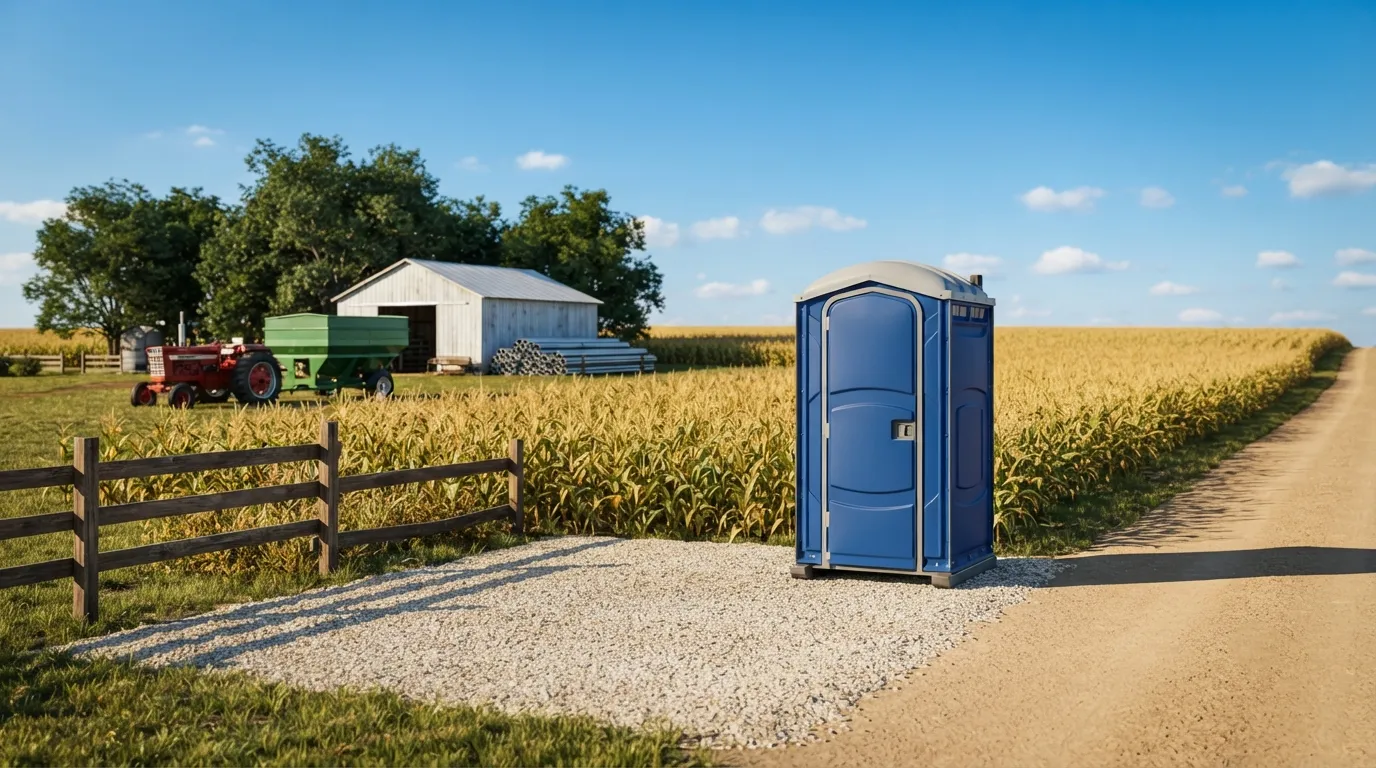
Count workers, not acres. One toilet covers 20 hand-labor employees under the field sanitation standard, and it needs to sit within a quarter mile walk, so a 200-acre spread with crews at both ends may need two units instead of one placed at the barn. Our how many porta potties do I need guide walks through the math for mixed crews, and the porta potty placement guide covers ground conditions, since a unit on soft field soil needs a stable pad, similar to the firm, slip-resistant surface called out in ADA Standards 302.1 for accessible routes.
Seasonal labor housing changes the picture too. If you run a bunkhouse or a labor camp during harvest, that population may need standard sanitation on top of field units, closer to what you would plan for event restroom rental or festival restroom rental work than a construction site. A deluxe flushable porta potty or a small 2 stall restroom trailer covers a camp better than a bare standard unit, and either can be serviced on the same route as your field units.
Farms tend to sit outside the core delivery zone, so drive distance affects both delivery timing and price. St. Louis Porta Pros already services Chesterfield, 19.2 miles west, and St. Peters, 27.0 miles northwest, both areas with working farmland mixed into the suburbs. Kirkwood sits 12.5 miles west and Florissant 15.4 miles north, both closer in if your operation is smaller and nearer the city. For a full list of towns we reach, see service areas or check the page for porta potty rental in Chesterfield directly if that is your closest hub.
| unit | duration | low | typical | high |
|---|---|---|---|---|
| standard | week | 130 | 200 | 500 |
| standard | month | 125 | 200 | 325 |
| deluxe | week | 150 | 250 | 290 |
A weekly rate usually makes more sense than a daily one for farm work, since crews are out there day after day through a planting or harvest window. Monthly terms often work best for a season-long setup, and the monthly porta potty rental page breaks down how that billing works. See the porta potty rental cost page for daily terms if you only need coverage for a short job like fence work or a barn repair.
Farms with a septic system for the farmhouse or a milking parlor also need regular pumping. A residential septic tank is typically pumped every 3 to 5 years depending on tank size and household use, and our septic pumping service page covers scheduling. If you run a roadside stand or commercial kitchen, a grease trap pumping plan matters too, since a grease interceptor needs service once fats, oils, and grease reach 25 percent of the liquid depth.
The industry baseline under ANSI/PSAI Z4.3 is one visit per week for up to 10 users over a 40 hour week. Farms with more workers or longer hours need more frequent service. See how often are porta potties cleaned for how that scales with crew size.
If units are clustered for a labor camp or event, at least 5 percent must be accessible, and never fewer than one, per ADA Standards 213.2. A standalone field unit for a small crew usually does not trigger this. Check ADA accessible porta potty for specifics.
Yes. Harvest schedules shift fast with weather, and we run emergency routes for farms mid-season. See emergency porta potty rental for how fast we can turn around a swap or extra unit.
A roll-off or trailer delivery needs about 60 feet of straight clearance behind the truck, but a standard toilet delivery is far more flexible. Call ahead so we can plan the route across field access roads near St. Louis.
Yes. A toilet alone does not meet OSHA 1928.110's water and washing requirement. Pair it with a portable sink rental or hand sanitizer unit to stay compliant.
Yes. St. Louis Porta Pros delivers farm and agricultural restrooms across St. Louis and the surrounding metro, with same-day and next-day drop-off available on most orders.
Pricing depends on the unit and how long you need it. See our cost breakdown and request a free quote for an exact figure.
Standard rentals include scheduled service — a pump-out, a clean, a restock and fresh deodorizer. Busy or hot-weather sites can be serviced more often.
Call now or request a free quote — clean units, on-time delivery, transparent pricing.